The marketing stack dictates infrastructure before content
Success in an earned media channel like organic search hinges on content. Specifically, on producing helpful content that has the ability to rank. Google has focused its recent algorithmic updates largely on promoting great content and natural links, and penalizing weak content with unscrupulous links (see also: Medic, BERT, and its legacy predecessors like Panda, Penguin, and Hummingbird).
But as SEO professionals prioritize content recommendations, keyword research, and link acquisition strategies (the more immediate factors in obtaining rankings), they risk devaluing technical changes — including site speed — that absolutely make clients more money on their existing organic audiences.
No content or channel initiative works without infrastructure (i.e. fast websites) and analytics. They are foundational to digital marketing success.
Content marketing is undeniably effective at getting sites to rank in search engines, which might satiate a client’s curiosity about what SEO can do for their visibility. And you might even be able to get slow sites to rank consistently, but the lack of attention to infrastructure will eventually come back to haunt you in conversion rates.
Site speed study
Sending prospective customers generated by good content to websites with slow experiences erodes trust literally by the second.
Our latest site speed study refresh looked at 10 websites spanning a number of industries and 26,000 different landing pages, ranging in performance from extremely slow pages (upwards of 9 seconds) to extremely fast (under one second).
The results showed that every second you can shave off your page load speed has intense conversion rate benefits that defy differences in verticals or selling approaches.
Pages that loaded in under one second converted at a rate around 2.5 times higher than pages that loaded slower than five seconds or more.
But the gains weren’t limited to fast vs. slow pages. The difference in conversion rates between “fast” pages (two-second load times) and “really fast” pages (under one second) was also more than double. This brings me to my next point.
Users will demand even faster sites
We first ran this survey in 2014 and, compared to today, the difference between “really fast” sites and “fast” sites wasn’t as stark as it is now. When we run it again in five years, expect the difference to be even more dramatic. Why? 5G adoption.
When you factor in both those trends, the only thing throttling a mobile or desktop user’s experience will be poor web infrastructure.
Prioritizing site speed
If you’ve read this far, then you’ll agree the conversion rate benefits of a fast site are significant and the marketplace demand for fast user experiences is widening quickly. But what practical steps should you take toward a faster page speed and which of those steps should you prioritize?
Moz, of course, has a great guide on page speed best practices. From that list, you have the following recommendations:
Enable compression
Minify JavaScript, CSS, and HTML
Rede redirects
Remove render-blocking JavaScript
Leverage browser caching
Improve server response time
Use a content distribution network (CDN)
Optimize images and video
If you were to reorder those recommendations in terms of difficulty to implement for the average search marketer and impact on site speed, it would probably go something like this:
Low difficulty, low impact
Optimize images and video
Marketers at any skill level can install a WordPress plugin like Smush and automatically reduce the size of any image uploaded in a piece of new or existing content. It saves a surprising amount of time when every image on a page is appropriately sized and compressed.
Minify JavaScript, CSS, and HTML
Minifying code is another quick win. There are plenty of tools out there that minify code, like minifycode.com. These tools essentially strip out all the spaces in the code, which can save a few kilobytes of size here and there. Those add up across an entire experience. It may take a developer to put these changes into place, but anybody can copy and paste code into the tools and send the minified version to the team doing the work.
Remove render-blocking JavaScript
Migrating to a tag management platform like Google Tag Manager can take the JavaScript weight off of your pages and put them in a container where they can load as fast or as slow as they need to without impairing the rest of the content or functionality on the page. Tag Managers are really easy to use for non-technical folks, too!
Medium difficulty, medium impact
The three recommendations below can be a little harder depending on who manages your CMS or existing web server. It could be as easy as clicking a checkbox, or as difficult as writing custom redirect rules on your setup. You’ll probably need to consult with either an IT and/or web developer to get these done.
Reduce redirects
Most SEOs can relay a URL redirect map to a client or internal stakeholder to determine server-side redirects with ease. But some sites include more complicated client-side redirect schemes using JavaScript. Working with a front end developer to tackle changes to script-based redirects can be tricky if those JS files impact the site functionality in other material ways.
Enable compression
Enabling compression in Apache or IIS is a pretty straightforward process, but requires access to servers and htaccess files that IT organizations are reluctant to hand marketers control over.
Leverage browser caching
Similarly, browser caching of website resources that don’t change very often is easy to do if you have control of the htaccess file. If you don’t, there are caching plugins or extensions for various CMS platforms that marketers can install to manage these settings.
High difficulty, high impact
Improve server response time
Common ways to improve response times include finding a more reliable web hosting service, optimizing databases that deliver functionality to the site, and monitoring PHP usages. Again, all these things fall under IT purview and require additional decision-makers and costs to execute.
Use a content distribution network (CDN)
Adopting a CDN can be time-consuming, expensive (hundreds or thousands of dollars per month per domain depending on site traffic), and require expertise that the average marketer or consultant doesn’t have to enable. But if you can do it, studies suggest Google is measuring time to first byte as a ranking factor and the payoffs can be huge.
Godspeed, everyone!
Hopefully, this inspires you to go out and make progress on site speed initiatives in your organization or for your clients. Not only is it worth the undertaking from a business perspective, but it’s actively making the internet a better place to be for the average person. Those are both things every search marketer can be proud of.
Sign up for The Moz Top 10, a semimonthly mailer updating you on the top ten hottest pieces of SEO news, tips, and rad links uncovered by the Moz team. Think of it as your exclusive digest of stuff you don't have time to hunt down but want to read!
As the dominant search engine, Google has a responsibility to provide timely resources and fight misinformation. Search Advocate Daniel Waisberg explains some of the company’s initiatives in this clip from Live with Search Engine Land.
Please visit Search Engine Land for the full article.
from Search Engine Land: News & Info About SEO, PPC, SEM, Search Engines & Search Marketing https://ift.tt/34RlztO
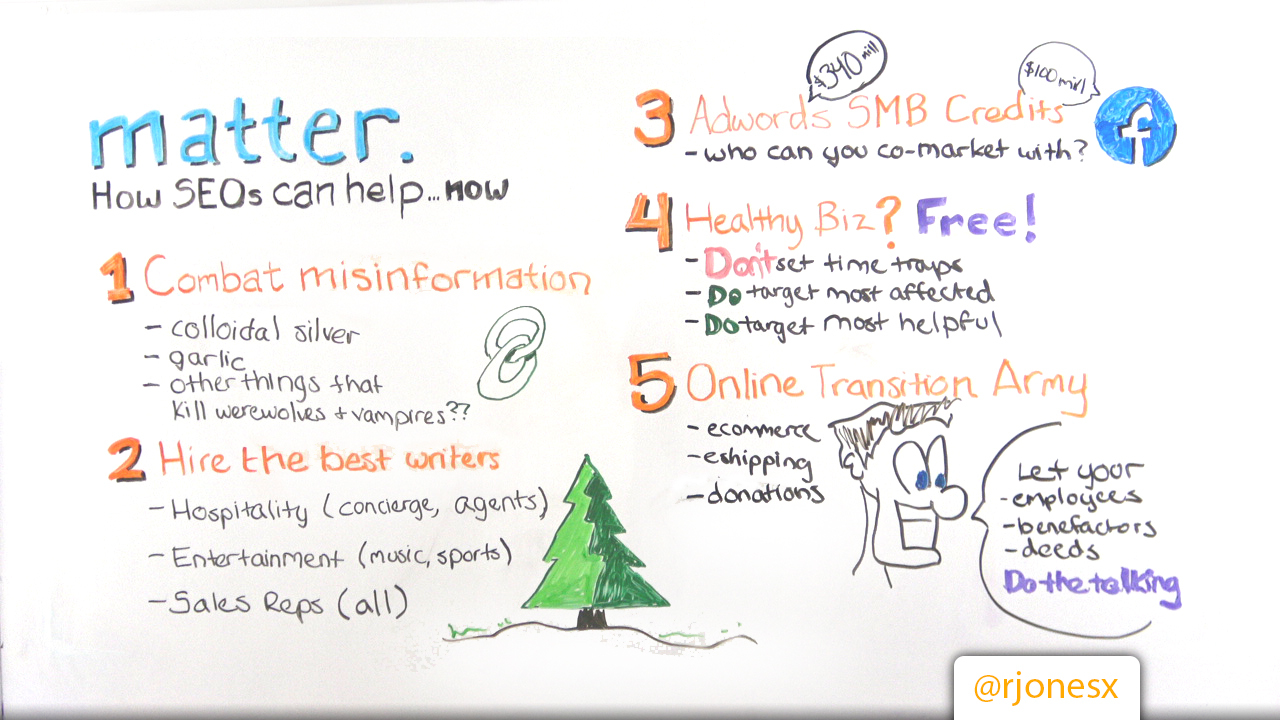
As SEOs, we hold a surprising amount of influence over how the world gets its information. In times like these, when businesses of all stripes are facing uncertainty and we may be looking for ways to help, the skills you use in your day job can be your superpower. In today's Whiteboard Friday, Russ Jones outlines five ways SEOs can make a difference amid the chaos of COVID-19 — just by doing your job and doing it well.
Click on the whiteboard image above to open a high-resolution version in a new tab!
Video Transcription
Hey, folks. This is Russ Jones here, Adjunct Search Scientist at Moz and Principal Search Scientist at System1. Today is my first day giving a Whiteboard Friday from my home here in Cary, North Carolina.
Unfortunately, it's with a somber attitude as many of you are at home right now realizing what's going on in the world. Normally, at this time of night, I figured I'd be having a scotch, so maybe I'll start with that. You see, we all need to relax a bit because things are tough and difficult.
But at the same time one of the things that's been troubling me a lot lately through this whole crisis has been how much do I matter? How do I make myself matter? Now, sure, I've got kids and a wife, so I work and I do things that help them to thrive.
But in my day-to-day job, most of what I do is work on search engine optimization and trying to get sites to rank, which can sometimes be really good and sometimes be really bad, and most of the time it's just somewhere in the middle. You're helping businesses do better.
How can SEOs help now?
But in a time like this, it almost feels like there's a calling for us to do something more. Today I want to talk a little bit about some of the ideas I've had on how as search engine optimizers and web professionals in general we might be able to matter just a little bit more and make just a little bit more of a difference during this pressing time.
So let's start off. How can SEOs help now?
1. Combat misinformation
Well, I think one of the first things that search engine optimizers have the ability to do obviously is to influence the search results. But we know right now that a serious problem that's plaguing social media and search engines and really just to all information in general is misinformation, information getting out there about what works and what doesn't to try and help stop the coronavirus.
Whether this information is well-intentioned or not is of no impact if it actually does cause harm. So as a search engine optimizer, one of the things that you have the ability to do is actually try and help out the sites that deserve to rank, the sites that are providing information.
I noticed if you were to search in Google for alternate cures for COVID, the first two things that would come up were colloidal silver and garlic. It seems like for some reason everything can be cured with the same stuff that kills vampires and werewolves. I'm not sure where this came from, but regardless it's there.
It's in the SERPs. In fact, you can search right now for how to cure COVID-19 with silver, and you'll find sites that rank that try and tell you this works, and we know it doesn't. So I'm not telling you that we should Google-bomb everybody out there who has a good website that's doing the right thing and providing good information.
But perhaps when you're writing your blog posts or presenting information online to your customers about COVID-19, you should take the time to think about: Who can I link to, what sites can I link to that are going to give information that will help my customers, and not just think of them as customers, but help their families?
So when you write an article about the discount that your business is offering, perhaps you might want to link to maybe the CDC's website, which will list off the different treatments available. Or if you run a local business, perhaps you can list off the various sites which are available for COVID testing. Now there are lots of different ways that we can go about this, and I'm not going to give you a list of sites that you should link to.
But there are probably sites that you visit almost every day, checking on the stats, seeing how things are going, and perhaps you should share those with the world and share them in a way that can make Google better.
2. Hire the best writers
Now the second thing that I want to bring up right now is actually an interesting opportunity. You see, right now, a lot of professionals, a lot of experts are simply out of work.
You see, as much as it's nice to be a search engine optimizer and work on a computer where you could be on the beach or in the basement or in a cubicle if you have to, but where you can work from anywhere, that's just not the case for most people in America. In fact, a recent study came out and said that only 40% of jobs could possibly be completed remotely, and that's possibly.
That's not meaning that they will be or that it's easy to or efficient to or effective to, just possible. That number is staggering. But there is one thing that we can tap into in these times, and that thing we can tap into is expertise.
You see, we always talk about producing evergreen content for our clients. I just gave a Whiteboard Friday a couple of days back about how it's difficult, as an SEO, to write content about things you are not an expert in. Well, for once, it turns out that there are lots of experts who need work and who would be let's just say the best opportunity you will ever have to produce truly evergreen content.
I mean think about the various areas of experts that are available to you. Hospitality, think about calling your local hotel and asking whether or not they can put you in touch with any concierge staff, even just by email. They know more about your city and about what tourists or individuals want in that city than perhaps anybody else.
Or you could talk about travel agents, and the same sort of information could be available to your website. You can understand how that if you're an SEO that works with a lot of local businesses, works with say a couple of different restaurants, well, then this concierge can then help provide you with third-party, unbiased information about these types of restaurants.
Then you can assist in the process of helping these restaurants move to an online and delivery service during their time of need. The same thing is true with entertainment. Recently an old employee of mine offered to fix the jingle, to come up with a new intro for some video production that Moz had made in the past. He's an incredibly talented individual. Luckily, he's also an SEO, so he can work remotely. But at the same time, maybe there's an opportunity to work with a truly talented artist or a truly talented musician to make the kinds of changes to your brand that you've always wanted to but have never been able to get access to.
Maybe the same thing is true if you're an information website and you write about sports, for example. Just because games aren't going on doesn't mean that the history of the sport doesn't need to be reported on and that there isn't an opportunity to produce some of the best content, the most reflective content that's ever existed on the web.
3. Adwords SMB credits
Then third I think we can tap into almost any kind of sales representative out there. These people not only pride themselves on the knowledge, but the knowledge that they have of the products that they sell is what makes them able to sell it. These types of sales reps, whether they're in technology, whether they're selling who knows, audiovisual equipment, it doesn't really matter.
What matters is the fact that they are experts and they have the unique capability to write about content better than anybody else. For once, for this short period of time, they're looking for that opportunity. So that's one thing that I want you to really focus on is the opportunity here for you to serve yourself and your customers and those in need all at the same time.
It's possible if you only look in all of the right places. Now that's not all that we can do. Now one of the things that has been really interesting has been the response of a handful of the larger companies or organizations across the world. One of them — or two of them, for that matter — have been Google and Facebook.
Both of them have announced just enormous sums of money that they are going to pour into free credits for small and medium businesses inside of their representative ad platforms. But here's the thing. They can't really distinguish between the small businesses that are going to suffer and the small businesses that are going to do well during these times.
They're not necessarily sure whether or not the local store that's advertising on their website is already set up for e-commerce or whether or not they're just trying to bring people to the front door. Well, here's a unique opportunity, and I normally give a lot of grief to people in the paid search space because I think search engine optimization is just so wonderful.
But this is really for you paid search folks out here. What kind of opportunities are there amongst your clientele where you can co-market, where you can work with your customers who are healthy in this time of need to co-market on behalf of the customers who are not? You see, people are going to wake up with credits in their account.
Some of them are going to need it, and some of them are not. You are in a unique position to put those people together. Right now, if you're thinking about how you can help, I bet most of your customers are wondering how they might be able to as well. By simply putting them together, maybe, just maybe you'll have an opportunity to do well by all of your customers and hopefully help some people out who really need it.
4. Healthy business? Help out by making your offer free
The fourth thing I want to bring up is something we've seen a lot, which is how healthy businesses of all sizes are responding. A lot of them are providing some sort of discounts or offers. I want to be really careful here because I don't want to say that providing discounts and offers in these times is in any way let's say taking advantage or not giving respect to what's going on.
It's actually really important that we seek out opportunities to help those in times of need. But I think that you really ought to be careful and be thoughtful and respectful of those who you will be helping in this manner. So one of the first things that I want to say is that if you are going to offer something, do your best to make it free.
You see, there aren't lots of businesses right now who are going through just a little bit of hurt. There aren't a lot of people out there who are just going through a little bit of hurt. We're talking about a lot of people going through really difficult times. The deeper you can dig, even if it's carved out specifically for the individuals or businesses that are in the most desperate of times, the better it's going to be for them in the long run.
Don't set time traps
Now one of the first tips I want to say is don't set time traps. I don't know what the word is for this, but I call them time traps. They're popping up left and right, which is, "Hey, we're going to give you the first X number of days free. Put in your credit card." It's a subtle but pretty obvious attempt that, over time, these individuals will forget about the credit card and hope that they end up just rolling into some payments that they otherwise wouldn't make.
Don't do that. If at all possible inside of your payment system, make some free trials or some free tools available to people that just don't require a credit card. That credit card right now is often meaning food for some of these people. So let's just be thoughtful.
Do target those most affected
Now what you can do is target those who are most affected.
For example, a lot of businesses are offering services and discounts specifically for the families of first responders, doctors, and any kind of individual who's been identified as an employee or a place of business that must be open, like your pharmacy. Now the reason why you want to target these people is they're having to put their lives on the line literally every day, even though that's not something they really signed up for when they got into the business. So the least we can do is offer them our biggest discounts.
Do target those most helpful
Third, we've got to be able to target those who are most helpful as well. You see, it's not just about the people who are in need. It's about the people who are helping those in need. I'll give you an example. Right now there's a serious crisis with domestic abuse in America.
You see, the quarantine has meant that people have had to stay home. It's, in that time, meant that the abused have had to spend more and more time with their abusers. Now there's probably a dozen domestic shelters within your area if you live in a larger city and certainly those across the state.
But how easy is it for those resources to be found? How much can they actually handle at this point? What do they need donations of? Do they need money? Do they need food? These are things you can find out and take advantage of.
But most importantly, as an SEO, you can help these organizations be easily discoverable, which is incredibly important right now, because people are in dire situations and need information fast. So there are opportunities here for you to offer services yourself, for the businesses that you support to offer services, and for you as an individual to simply contribute to all sorts of different individuals who are doing their best to get us through this crisis.
5. Online transition army
Now the fifth thing I'd like to think about is some sort of online transition army. Now most of us here are some sort of web professional or we own a business that has a website. But in all that we have done, there is some degree of experience that involves putting a business online or putting an organization online.
Whatever that skill is that you've developed — maybe it's e-commerce, maybe it's shipping, maybe it's paid search, who knows what it is — it's time to pick up the phone and start calling the organizations that don't have this kind of representation and help them make the transition.
We know that there are tens of thousands of talented SEOs across the country and even more search marketers and even more web designers and developers. We know that they've got free cycles. I know I do. I'm recording this right now at I think it's about 9:30 EST. It was either this or Netflix.
We have the opportunity to make a really big difference. So whether that's helping a local business create an e-commerce version or helping them with shipping or even more often than not helping nonprofits collect donations online, there are just tons of opportunities for you and your organization to get involved and help make a difference for the companies that aren't already online.
Now I know you could think about this from the other direction, which is to say my business and my clients are online, and now is our chance to win because our competitors just weren't prepared. This is one of those times where I think you've got to question whether or not you really want to bring that karma upon you.
Now is the opportunity to matter.
The last thing I would recommend is to let your employees and your benefactors and your deeds speak for themselves. You don't need to go out touting left and right all of the things that you're doing.
Certainly you should advertise the offers that you're giving so that you actually extend the reach. Certainly you should advertise the fact that you're looking for nonprofit organizations to help out online. While you should do that, the question you should ask yourself before you put out any kind of information about what you've done, about how you've helped is whether or not the time you're spending putting together that information and the dollars that you're spending putting out that information is worth the cost of the good that you could have done with that time and money doing something else.
Share your ideas in the comments
Now I want to end on a positive note. These are difficult times. But if there's one thing that I've seen time and time again is that people in our industry care and they're trying to make a difference. Now these are just some of the ideas that I came up with, and I'm betting in the Moz audience and across the Twittersphere and Reddit and all of social media that there are people who have other excellent ideas.
I want you to fill the comments with those types of ideas, and we'll do our best to promote them. Thank you again for spending another Whiteboard Friday with me. God bless. Be healthy and I'll see you soon again. Bye.
Sign up for The Moz Top 10, a semimonthly mailer updating you on the top ten hottest pieces of SEO news, tips, and rad links uncovered by the Moz team. Think of it as your exclusive digest of stuff you don't have time to hunt down but want to read!